Andrea Lacorte won the owner-driver title in his first 52 Super Series season, powered by Doyle Sails – and with four Doyle sailmakers on board.
Words by Ivor Wilkins for Doyle Sails | Published Seahorse Magazine January 2026
The just-concluded 2025 TP52 Super Series season reaffirmed the intensity and high-level competition of the class with 12 of the 13 teams scoring at least one race win and nine posting two bullets or more.
Class veteran Doug De Vos bowed out in style with his seventh championship title. But, as one class stalwart quit the stage, a newcomer to this high-octane circuit turned heads with an outstanding first season.
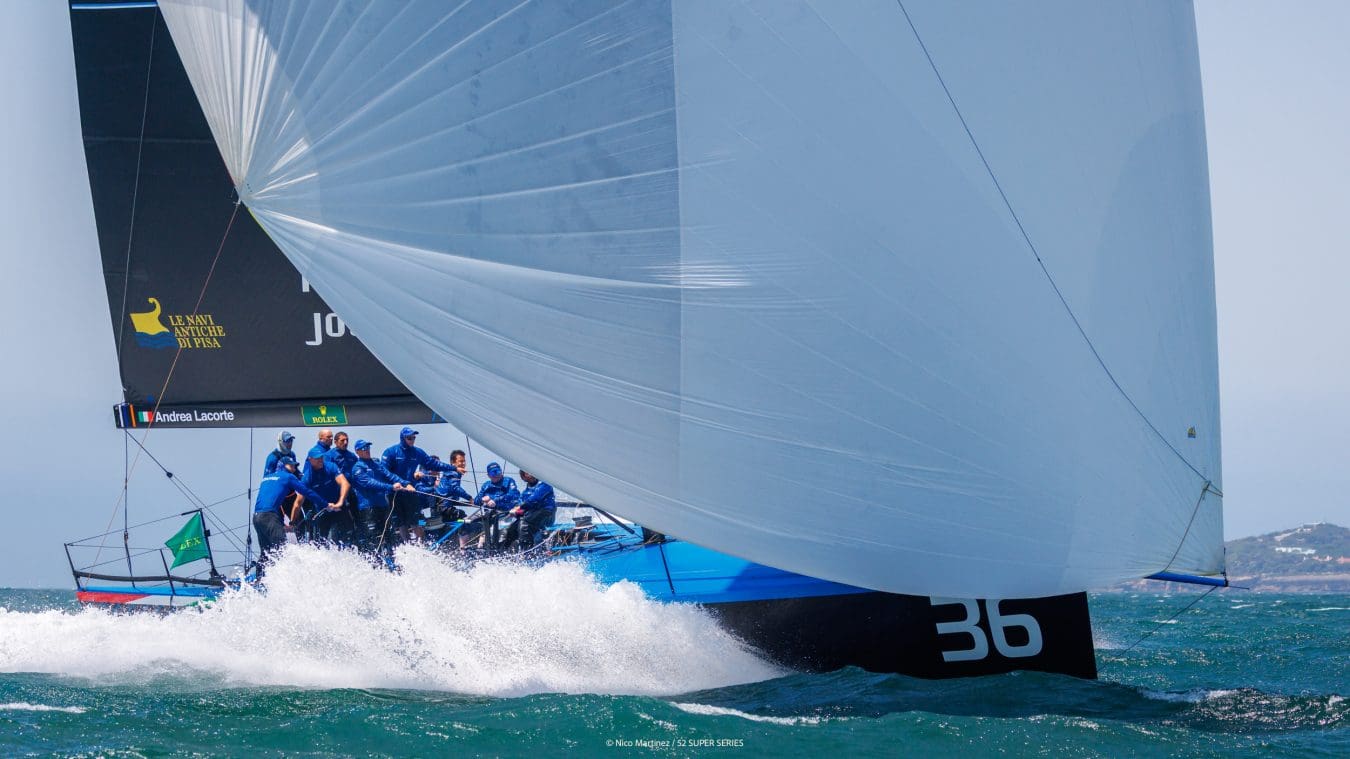
In the season-long standings, Italian Andrea Lacorte and his Alkedo Powered by Vitamina team won the owner-driver title and finished 4th overall in the star-studded fleet.
It was an astonishing result for a debutante team. With total respect for a class brimming with America’s Cup and top ocean racing talent, Lacorte’s rookie season ambitions were kept well in check.
“My goal was just to finish above the last two places, somewhere around the middle of the fleet,” Lacorte admits. “What actually happened was far beyond expectation.”
Leading up to the leap into what he regards as the pinnacle of owner-driver racing, Lacorte raced a succession of yachts, including Melges 32s, Swan 36s, Swan 50s and high-performance M32 catamarans. For the past 15 years, he has sailed with professional crew under his Team Vitamina banner.
Lacorte embodies a curious paradox: he is passionate about speed and adrenalin, yet brings tremendous patience and meticulous preparation to his projects.
“Sailing was a family affair,” he says. “My father, my brother and I were out on boats from a very young age. That is where my addiction to this silent movement across the sea began.
“Racing and competition is in our DNA,” he continues. His brother and business partner, Roberto, went into motorsport and continues to race in the top Le Mans Prototype 2 category with team AF Corse/Ferrari. “He is probably the fastest non-pro driver on the circuit,” says Lecorte.
As a youngster, despite his early “addiction”, Andrea Lacorte did not take up sailing as a sport and never went through the usual progression of youth dinghy classes.
Through his teenage years and later at university, he expressed his need for speed in motorcross racing and then set about establishing multinational companies in the world of animal and human nutrition and nutraceutical products.
“I did not have time for sailing through those early years, so I was 40 before I was able to take it up as a sport.” Even then, he continued to exhibit extreme patience, serving a racing apprenticeship of eight years – moving up through various roles on a boat – before taking the helm.
Likewise, he took his time considering the decision to step up to TP52 Super Series level. “Over the past couple of decades, I have been viewing the class as the ultimate jump,” he says.
Some associates advised against it as a leap too far, but Lacorte was determined to take on the challenge. “Listen,” he told the doubters, “I’m 65 years old and it is about time to make that final jump now, while there is still time to compete at that level as long as possible.”
By his side throughout his yacht racing pursuits has been his team manager Matteo de Luca, who began preparing a TP52 budget and campaign plan four years ago. When Lacorte gave the go-ahead at the end of the 2024 season, the first step was to beat off strong opposition to acquire Interlodge, whose owners, Austin and Gwen Fragomen, were retiring from the class.
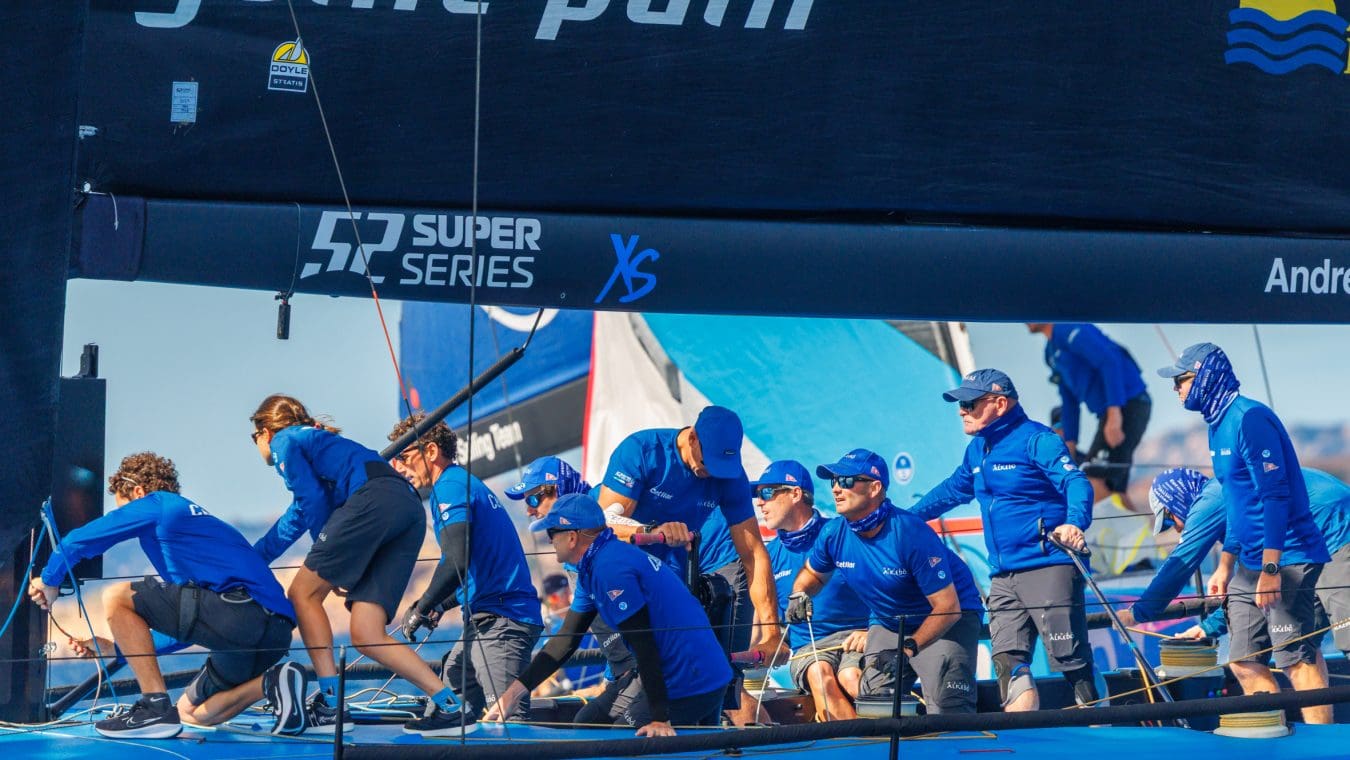
The next crucial step was to sign up five Interlodge crew members to integrate with Lacorte’s existing Vitamina team. The final line-up included four from Doyle Sails – Cameron Appleton, tactician, Luke Molloy, runners/trim, Dave Armitage, upwind trim and De Luca, bow and team manager – occupying key roles in the strategic and performance areas of the boat.
“Interlodge was a Doyle-powered boat for a number of years, particularly with upwind sails,” says Appleton, “so we had a really good understanding. Along with Platoon, we had evolved the sails and been able to work well together between designers Jordi Calafat and Dave Armitage.
“That has continued into this programme as well. We brought about 14 new upwind sails on board for the 2025 season.” The designs for an owner-driver boat are no different from an all-pro lineup, according to Appleton.
“You design the best sails you can for the aero package, the balance of the rig, and the ability to power up earlier than the other teams, particularly in light air.
“You are always designing the sails for the optimum shapes you need to cover the different wind ranges. Then, if necessary, you can tweak the package to be a bit more forgiving or a bit more locked in through rig tune, sheeting set-up and how you mode the boat.”
De Luca emphasises that sailing talent, technical skill and high performance were the sole criteria in crew selection. No room for sentiment or particular brand affiliations.
“Andrea and I talked a lot about the crew selection for this project and it was only ever about the best people for making the boat go fast. In the past we may have chosen people we like, or had a good attitude, or were nice to have around the team,” he says. “Not this time. It was only the best, with no compromises.”
When it comes to technical and equipment decisions Lacorte confirms he leaves it to De Luca and the professionals. “I like to know what they are doing, of course, but with those details I have to trust the people who know the boat and have specialist expertise.”
Talent and technical skill are of course vital at this level, but so too is crew compatibility – particularly with multiple cultures combining to operate primarily in English. A vital question was whether the merging of two teams and different cultures would work.
As Lacorte put it: “It was important to make a good cocktail and not an unflavoured minestrone.”

Following an intensive three-month refit – including a significant and beneficial keel modification – the new crew assembled for a February training session in Valencia. Whether they would emerge as cocktail, or soup was about to be tested severely. Just eight minutes after sheeting on to start the team’s first training session, the mast crashed over the side.
In the race against time that followed, adversity would mould unity as everyone pulled their weight to source and refashion a replacement. It involved missions by planes, trains, cars – even a bus, which transported the replacement spar from the UK.
From the dismasting in February, team members fanned out across Europe and to and from Sri Lanka to unite all the requisite parts and fittings to rig and step the mast in time for an April training week in Valencia involving seven Super Series boats.
“It was unbelievable,” recounts De Luca. “The team mentality and atmosphere of cooperation were born together with this mast.”
Lacorte describes the herculean effort as “the trigger in creating a super-strong, united entity, without which we would not have made it to the first race”.
Apart from the team bonding effect, the mast episode had other benefits. “It turned out the replacement rig was actually an improvement over the original,” says Appleton. “It was really good to see our sails fit so well with the new set-up and give us the platform we needed to keep progressing our performance.”
Work on refining the rig and adapting the boat structure to accommodate higher loads continued throughout the season, incrementally working to extract its full potential.
After averting what could have been a season-ending disaster, joining the fleet in time for the opening regatta at St Tropez represented a victory in itself. In the light, flukey Mediterranean conditions, only four of the 10 scheduled races were completed. But Race 3, proved a major milestone for Alkedo V, delivering its maiden victory.
“As we crossed the line, I couldn’t believe what was happening,” recalls Lacorte. “That was the moment when I understood that the class is feasible. It is human, even if we are racing against the very best sailors in the world, with their gold medals and America’s Cup experience.
“We capitalised our experience. We have done a lot of one-design racing where it is hand-to-hand combat, so that was not something new to me. What was new was this boat and the very high level of the competition.
“We saw that when we do not make mistakes and our tactics are right, we can win races. Our crew and particularly tactician Cameron Appleton are among the best in the world. The most important thing is not to make mistakes.
“The racing is so tight that even one little mistake can have a gigantic effect on your position – as much as seven places. At times you see the first nine boats crossing the finish line within 10 seconds.
“We are new to the class, so we will make mistakes, but as far as boatspeed and boat-handling are concerned, we showed we can stay in the fight.”
Cascais was at the other end of the range, dishing up winds close to 30 knots with big seas. “I was really nervous about Cascais,” says Lacorte. “We learned fast. Eight sailing days and every day the boat was planing between 18-22 knots downwind, with big wind shifts.”
This was the adrenalin rush Lacorte had been missing over the previous decade or so in displacement keelboats with wheel-steering. “He missed the excitement and engagement of tiller-steering fast planing boats like the Melges 32s and the M32 catamarans, with water and spray all over the boat,” says Matteo De Luca with a laugh.
And, despite the nerves and physicality of the Cascais event, the team added two more wins to its scoresheet.
Cascais was also the class World Championship event for 2025. Alkedo V finished a highly creditable 5thoverall and Lacorte missed clinching the owner-driver title by just a single point.
Over the five regattas of the season, Alkedo V scored six bullets – an extraordinary showing for a rookie team. “We know that any team in this class can have a good regatta, or a bad regatta,” says De Luca. “We felt very satisfied to have achieved that level of consistency throughout the season.”
Cameron Appleton adds: “As the season went on, we gained confidence that when we string it all together and do all the right things, we can actually compete very well. The crew really bonded and worked super-hard.
“I think everybody was proud and pleased with what was achieved. You could say we surprised ourselves, but I also think the results were deserved.
“Andrea is super-dedicated and focused. He has developed a wealth of knowledge from competing in a bunch of different classes and has a good understanding of what is required.
“The guys on board push him really hard and he stands up to the challenge every day. They are long days and tough races, but we showed we were able to fight hard for every position.”
Ironically, the final event of the series at Porto Cervo returned their worst result, robbing them of a podium finish for the season championship. “We lost third place overall in the second half of the last leg of the last race of the last event,” Lacorte recalls ruefully. “Wow. That shows how tough the competition is.”
As team manager Matteo de Luca analyses data and debriefs from this season to finalise a strategic plan for 2026, he has already identified a significant challenge. “We came into 2025 with quite modest goals and expectations,” he says. “After these results, we will be under much more pressure to do even better next year.”
For Andrea Lacorte, who relished his debut in a class that demands total mental and physical commitment, challenge is the attraction that fuels all his sporting and business endeavours.
He is all-in for the TP52 Super Series battles to come and excited that three new owner-drivers look set to step into the ring next year.
ABOUT SEAHORSE MAGAZINE // Take advantage of our very best subscription offer or order a single copy of this issue of Seahorse.
Online at: www.seahorse.co.uk/shop
Or via email: subscriptions@seahorse.co.uk
ABOUT DOYLE SAILS // Doyle Sails strives to deliver success through high-performance, high-quality, custom sails that continue to redefine the boundaries of sailmaking technology and innovation; whilst connecting sailors to inspire, support and encourage sailing.
Our obsession with sailing takes us to every corner of the world and onboard every yacht. We become part of teams, share in the adventures of friends and families, sharing our knowledge and experience with those with the same passion. Sailing is in our DNA, and we are the custodians of a legacy that has been supporting sailors for four decades and counting.